SQL
From reading execution plans and index design to rewriting correlated subqueries and using BULK COLLECT — practical Oracle SQL optimization techniques that make real differences in production systems.
From reading execution plans and index design to rewriting correlated subqueries and using BULK COLLECT — practical Oracle SQL optimization techniques that make real differences in production systems.
Interactive Report or Classic Report — which belongs in your Oracle APEX application? This practical comparison covers features, limitations, performance, and a clear decision guide to help you pick the right report type every time.
 Oracle APEX
 From APEX Accounts and LDAP to custom authentication functions and Social Sign-In — this guide covers every APEX authentication option, how to write custom authentication logic, post-login processing, and essential security hardening steps.
Write PL/SQL that handles errors gracefully. This guide covers predefined exceptions, user-defined exceptions, SQLCODE, SQLERRM, RAISE_APPLICATION_ERROR, exception propagation, and a production-ready error logging pattern.
 SQL
SQL Master Oracle SQL window functions — ROW_NUMBER, RANK, DENSE_RANK, LAG, LEAD, SUM OVER, moving averages, and more. Real examples that show you exactly when and how to use each function in production queries.
From implicit cursors to explicit cursors, Cursor FOR Loops, and REF CURSORs — this guide covers everything you need to know about cursors in PL/SQL, with practical code examples and clear guidance on when to use each type.
Record Groups power LOVs, dynamic dropdowns, and in-memory data processing in Oracle Forms. This guide covers all three types, key PL/SQL built-ins like POPULATE_GROUP and POPULATE_LIST, dynamic queries, and common pitfalls to avoid.
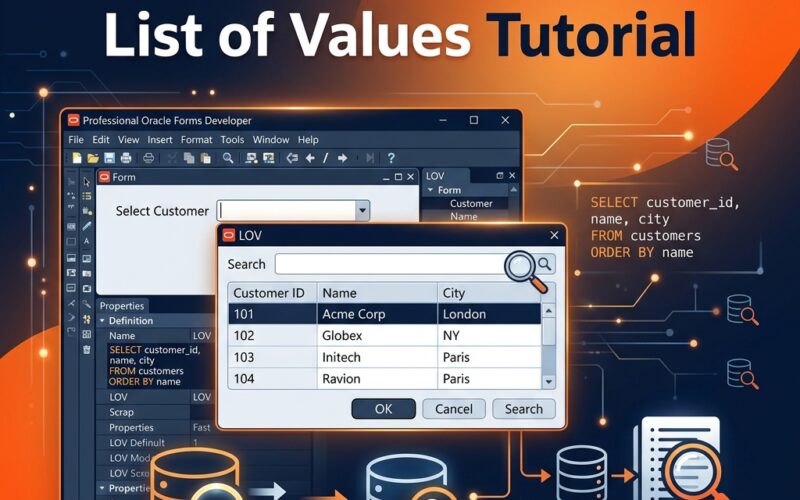 Oracle Form
 Everything you need to know about Oracle Forms LOVs — how to create them with the wizard, link them to form items, write dynamic queries with bind variables, use KEY-LISTVAL triggers, and troubleshoot common problems.
Learn how to create a multi-row block in Oracle Forms — from using the Data Block Wizard to configuring tabular layouts, scrollbars, visual attributes, and master-detail relationships. A complete practical guide.